
PETER, PAUL AND MARY
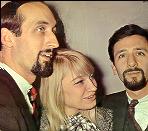
"Peter, Paul and Mary are folk singers." So stated the liner notes to the group's self-titled 1962 debut album. Today, this declaration seems redundant, because the term "folk music" has come to be virtually interchangeable with the group name, but when the words were written, they were meant less as a stylistic distinction than as a mission statement.
In the decades prior to the '60s, through the work of such avatars as Woody Guthrie, the Weavers and Pete Seeger, folk music had become identified with sociopolitical commentary, but the idiom had been forced underground in the Senator Joe McCarthy witch-hunting era of the late '50s. By the time Peter, Paul and Mary arrived on the scene, for the majority of America, folk was viewed merely as a side-bar to pop music which employed acoustic instruments. At this critical historic juncture, with the nation still recovering from the McCarthy era, the Civil Rights Movement taking shape, the Cold War heating up and a nascent spirit of activism in the air, Peter Yarrow, Noel (Paul) Stookey and Mary Travers came together to juxtapose these cross currents and thus to reclaim folk's potency as a social, cultural and political force. But few at the time could have realized how fervently and pervasively the group's message of humanity, hope and activism would be embraced.
Having their music associated with causes and solutions is as natural as breathing for Peter, Paul and Mary. The music they purvey and the action it generates are equally important to them and lie at the heart of their story. Most recently, their individual and collective efforts have focused on such crucial issues as gun violence against children, the rights and organizing efforts of strawberry pickers in California, homelessness and world hunger. "We've always been involved with issues that deal with the fundamental human rights of people, whether that means the right to political freedom or the right to breathe air that's clean," Travers points out.
No American folk group has lasted longer or amassed a more loyal following than Peter, Paul and Mary; indeed, few groups of any genre have logged more years (45) or miles (countless) in direct, yearly touring; spreading the message and engaging the next (now four) generations. During its now legendary career, the trio won five Grammy's, produced 13 Top 40 hits, of which 6 ascended into the Top 10 - as well as eight gold and five platinum albums. That PP&M achieved such a rarefied level of commercial success without compromise, and while continuing a centuries-old tradition of people raising their voices in song for the sake of freedom, is simply further evidence of their extraordinarily successful career-as much a mission accomplished as a musical career.
In 2006, Peter, Paul and Mary received the latest in a long line of honors bestowed on the group: The Songwriters Hall Of Fame's Lifetime Achievement Award (also known as the Sammy Cahn Award). It's well-earned recognition that the group has mastered the art of topical songs-which can be overly directive, one-sided and preachy in less-seasoned hands. "The songs we sing invite the participation of the listener, who is central to finding a way of creating the life of the song at that listening," Yarrow explains. "It's the difference between poetry and didactic writing. One tells you, 'This is it,' and the other says, 'Let's find this together.'" Adds Stookey, "Whether it's your own material or somebody else's material, it's essential that you identify with it thoroughly. It's like you want to archive it; you want to freeze it in time in terms of your perspective on it, then move on, because folk music is that volatile and comments not only on overall human concerns but also on the specifics."
Yarrow, Stookey and Travers have spent their years together communicating personal, political and social imperatives by way of their impeccably chosen songs, personally crafted harmonies and unmitigated passion. Remarkably, more than four and a half decades after their formation, they're still singer/advocates. Their spirits and sense of purpose are undiminished and their message, if anything, is more relevant than ever before, particularly as America and the world approach what Travers characterizes as "a critical turning point in time."
Through the years, that message has been expressed through traditional ballads like "The Three Ravens" and "Take Off Your Old Coat," the work of such latter-day poets as Woody Guthrie, Pete Seeger, Bob Dylan, Laura Nyro, Gordon Lightfoot, Tom Paxton, Phil Ochs and John Denver, and in songs penned by the group itself. It's a canon of classics-indelible, important songs like "Blowin' in the Wind," "If I Had a Hammer," "Cruel War," "Leaving on a Jet Plane," "Where Have All the Flowers Gone," "500 Miles," "Lemon Tree," "In the Early Morning Rain," "All My Trials," and "Puff (The Magic Dragon)," among others.
Released in March, 2004, Rhino's Carry It On boxed set features four CDs filled with such memorable musical moments from 1960 to 2003, including previously unreleased solo recordings by each member made prior to the group's formation. The package also contains a bonus DVD with performance footage of some of the trio's most iconic songs, including a live version of "If I Had a Hammer" from the 1963 Civil Rights March on Washington, where Dr. Martin Luther King Jr. delivered his famous "I Have a Dream" speech. Among the many luminaries offering testimonials in the Carry It On liner notes is the late Coretta Scott King, who proclaimed, "Peter, Paul and Mary are not only three of the greatest folk artists ever, but also three of the performing arts' most outstanding champions of social justice and peace. They have lent their time and talents to the Civil Rights Movement, labor struggles, and countless campaigns for human rights for decades, and their compassion and commitment remain as strong as their extraordinary artistry."
Carry It On was released simultaneously with In These Times, the group's first all-new studio recording in more than a decade. The LP features no solo turns, only group vocals-an approach PP&M haven't employed since their first four albums; their singular harmonies displaying unity in the face of a particularly fractious, and in their opinion, dangerous, era. "With In These Times, we wanted to make a contemporary statement," says Stookey. "Folk music has the capacity to not only be aware of the continuum, but also to offer thoughts that are perspectives on the immediacy of human concern."
Both timely and timeless, In These Times (co-produced by Yarrow and Stookey) spotlights selections penned by new or newly discovered writers including Tim Bays, Dave Allen, Anne Feeney, Gene Nelson and Bill Staines, offering wider exposure to fresh talent - long a PP&M tradition. In the past Peter, Paul and Mary put together new material for every summer tour, so the album actually collects several years worth of new material. Much of it is drawn from the Kerrville Folk Festival in Texas, an annual event whose New Folk Concerts are arguably the most important platform for the discovery and acknowledgment of new singer/songwriters in America.
In 2004 Carry It On, the boxed set, and an accompanying PBS TV special focused plenty of attention on the music of Peter, Paul and Mary, but the following year observers were more preoccupied with Mary Travers' health; she underwent a successful bone marrow transplant in April of 2005 for leukemia. That December, Travers joined Peter and Noel (Paul) on stage for the first time in a year to perform their renowned and much loved Holiday Celebration benefit concert at Carnegie Hall. "The emotionality of the response, and the love of the audience for Mary, showered the stage," observed Peter. Today the three singers stand strong in their musical mission, and are eager to carry it on to new audiences.
Some Historical Notes and Thoughts on the Trio:
Forming at the dawn of John F. Kennedy's presidency, when the tight lid of repression was about to blow off of the American sociopolitical stew pot, the trio emerged just as their nation was coming to grips with long-deferred issues of social and political justice, foremost among these the demand for racial equality. Through the airwaves, which came to be dominated by their music of conscience, and their relentless schedule of concert performances, many of which took place on college campuses, they helped to inspire and awaken the nation as it united in song and spirit, to finally stand up for its pledge to be a country with liberty and justice for all. During this remarkable era of reckoning, Peter, Paul and Mary reached out to personally touch the lives and hearts of tens of millions of Americans with their songs-a message they lived as much as they sang.
Peter, Paul and Mary came together during an unusually fertile period in popular music. Yarrow, who had come to Greenwich Village with a psychology degree from Cornell, recalls that "The Village in the early 1960s was a crucible of creativity. Involvement in music was a matter of joyous discovery, not business. We knew that folk music was having an enormous impact in the Village, but was a couple of years away from being embraced on a national scale."
The Village was also the starting place for Stookey, a fledgling stand-up comic from Maryland who'd recently graduated from Michigan State. Stookey met up separately with Yarrow, who was playing Village coffeehouses as a solo act, and with Travers, who was already known for her work in the Song Swappers, a folk group that had recorded with Pete Seeger. Having grown up in the Village, the flaxen-haired singer was a familiar figure at the Washington Square Sunday singing event. Encouraged by folk impresario Albert Grossman, who became their manager, the three artists decided to throw their lots together after blending their voices for the first time in Stookey's Lower East Side apartment. Peter, Paul and Mary made their formal debut at Greenwich Village's Bitter End in late 1961.
The group's self-titled 1962 debut on Warner Bros. Records, a stunning oasis of content in a sea of musical fluff, brought folk music of consciousness and concern to the top of the charts. Fueled by the enormous hits "Lemon Tree" and "If I Had a Hammer" (which enjoyed a second life as an anthem of the Civil Rights Movement), the album went straight to #1, remaining in the Billboard Top 10 for 10 months and in the Top 20 for two years on the way to a remarkable three-and-a-half year run on the album chart. In 1963, they released the LPs Moving and In The Wind, which hit #2 and #1, respectively, and continued to hold Top 20 positions alongside the first album.
This success marked the beginning of an incredibly fertile and influential time for the group, and for the contemporary urban folk tradition they personified. Their commercial high water mark occurred in the third week of November 1963, when they held three of the top six positions on Billboard's album chart (ironically, that was the very week President Kennedy was assassinated). That same year, their recording of "Puff (The Magic Dragon)," co-written by Yarrow and Leonard Lipton, won the hearts of millions, and went on to be an enduring children's classic.
"'Puff (The Magic Dragon)' became metaphorical for a certain spirit because of its proximity to the era or idealism and hope in the '60s," says Yarrow. "If it had been written in a time of cynicism and selfishness such as this one, perhaps 'Puff' might not have resonated in the same way, save for those who were bemoaning the loss of innocence of their own time." Meanwhile, their recording of "Blowin' in the Wind" helped introduce a fellow Village songwriter (and Grossman client) named Bob Dylan. This was folk music as an agent of social change, and it was to spark the imagination and the passion of a generation intent on social change.
But Peter, Paul and Mary did more in those times than chronicle events-they lived their songs. When they sang at the 1963 March on Washington, and two years later at the Selma-Montgomery March, these courageous gestures, made under threat of violence, were nothing less than radical acts, launching more than four decades of ceaseless musical activism. "You have to put your body on the line from time to time in order to make a statement or change a law," Stookey asserts. "Protest is inherent to this system," adds Travers.
In 1969, as the turbulent decade was drawing to a close, Yarrow co-organized the March on Washington, and Peter, Paul and Mary sang before the half-million people who had come together for that landmark event.
The following year, needing time for personal growth, the group disbanded, and each member began pursuing individual interests. Stookey's spiritual commitment led him to pen "The Wedding Song," record eight solo albums (one of which received a Grammy nomination) and create a multimedia organization that is still involved in a variety of children's computer, television and music projects. Travers recorded five albums; produced, wrote and starred in a BBC television series; and lectured and concertized across the country. Along with his ongoing political activism and solo projects, Yarrow co-wrote and produced Mary McGregor's #1 single, "Torn Between Two Lovers." His three animated TV specials for CBS based on "Puff (The Magic Dragon)" earned Yarrow an Emmy nomination.
Fittingly, it was an important cause that reunited the erstwhile partners. In 1978, at an anti-nuclear benefit at the Hollywood Bowl that he had organized, Peter asked Noel and Mary to join him on stage. "We hadn't sung together in six years," Travers recalls. "We realized that we'd missed each other personally and musically, so we decided to try a limited reunion tour. We wanted to work together enough to have it be a meaningful part of our lives, but not so much that it wouldn't be fun." Looking at the chemistry that's still so potent, Mary observes that, "Each of us has a talent that's pivotal for the group. Peter is a patient and meticulous worker, especially when it comes to sound quality, and that commitment to excellence is what yields the best possible environment in which to be creative. Noel has a relaxed sensibility, and that's a very calming influence when it comes to adjusting to difficult situations, which happen all the time. Of course, both are talented songwriters as well. I think I bring a spontaneity, an ability to connect with them emotionally and focus our attention on having a musical conversation. I believe that if we can have that conversation, then the audience will feel included."
With "No Easy Walk to Freedom," the title track from their 1986 album, Peter, Paul and Mary focused attention on the Anti-Apartheid cause, and were honored by the Free South Africa movement at a special benefit at the Kennedy Center in Washington, D.C. That same year, they were among the vanguard of artists who worked to raise the public's awareness of homelessness. Their opening night of a week on Broadway was a fund-raiser on behalf of the New York Coalition for the Homeless. These efforts all marked the group's 25-year association and culminated in their PBS special, 25th Anniversary Concert, which was broadcast in support of public television
In 1988, Peter, Paul and Mary became the focus of yet another special for PBS with A Holiday Concert, taped before a live audience in New York City. For this performance, they were accompanied by the 160-member New York Choral Society and a 40-piece orchestra. Their renditions of holiday music were captured in the album, A Holiday Celebration.
In 1992, Peter, Paul and Mary re-signed with Warner Bros. and recorded Peter, Paul & Mommy, Too, their second children's album. (Peter, Paul and Mommy, released in 1969, was the name Mary's daughter Erika once gave her mother's group.) The album and video received Grammy nominations.
The uniting of three generations of folk singers on their 1996 TV special and album, LifeLines, offered them the opportunity to sing with their mentors, their contemporaries who started with them in Greenwich Village and new singer/songwriters who are carrying on the time-honored folk tradition. Participants included onetime Weavers Ronnie Gilbert and Fred Hellerman, Richie Havens, Tom Paxton, Odetta, Dave Van Ronk, John Sebastian, Buddy Mondlock and Susan Werner. The vitality and resilience of the folk community were the hallmarks of this memorable collaboration.
The group's message, more and more, is that their music belongs to everyone. In this, their fifth decade together, Peter, Paul and Mary can be viewed less as performers than as purveyors of a universal, accessible language that fosters universal recognition, mutual validation and empowerment. We can all draw encouragement from the fact that Peter, Paul and Mary are still together, still free of cynicism and still filled with hope.
"People can overcome their differences, and when united, move toward a world of greater fairness and justice," says Yarrow. "As in folk music, each person has a unique role to play."
Adds Stookey: "We live in more pragmatic times than when we originally recorded those songs. But many of the dreamers of the '60s have been elected to governmental office or taken on a leadership role in their communities. They are now in the position to make a difference."
The conviction that each individual can make a difference has continued to energize Peter, Paul and Mary's political and social activism through the years. Having witnessed the enormous changes in society that were wrought by the early advocacies of which they were a part, the group remains optimistic as it confronts the challenges and pervasive cynicism of our times.
The legacy the trio inherited as well as the legacy they leave will continue to inspire, because theirs is a music and message of activism and hope. Current and future generations will find no better validation of their own search for social equity than the enduring music of Peter, Paul and Mary: Carry It On and the contemporary thrust of In These Times.
"I think the new album will be a wake-up call to the fact that folk music has never really gone away-it's just manifested itself in a lot of different disguises, whether it's Springsteen, Sting or Bruce Hornsby, all of whom happened after the '60s, which was the opening of the awareness that songs could be about anything," Stookey says.
"Folk music has a sort of a bubbling-under quality," Travers asserts. "The stream runs through the cultural consciousness, and whether or not it's on the radio is not the issue. Folk music is always there."
"The wonderful thing," she continues, "is that there is this incredible wealth of material, the result of 40 years of trying to find the best of our contemporary writers and the best of the traditional stuff. Now there's this huge box set, and it's all there. People 50 years from now will go back and listen to those tunes. This music is not going to disappear."
January 2007